
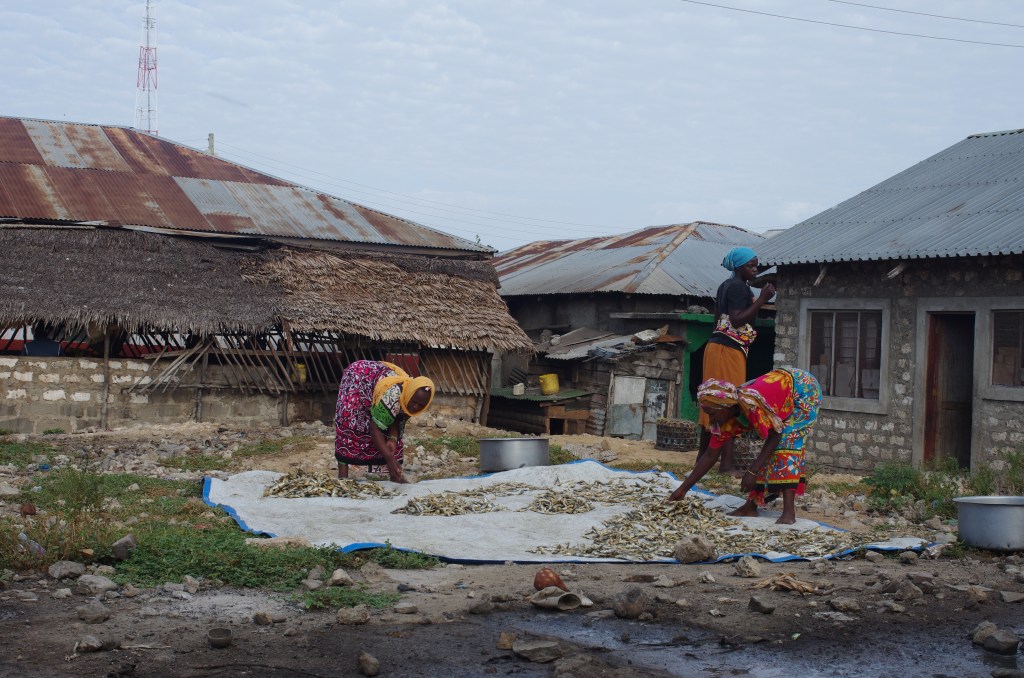
©Mouna Chambon – Fish processing is a female-dominated activity in Kenya. “Mama chemshas ” are the ones boiling and selling sardines. They get the fish from fishermen, boil and dry it before selling it to customers.
While women globally make up nearly half of the fisheries workforce, their contribution to the sector has long been overlooked with implications for fisheries management. To assess women’s participation in small-scale fisheries management and related socio-cultural, environmental, and economic impacts, a team of researchers has conducted a systematic review of peer-reviewed literature containing 124 case studies spanning 51 countries.
In this interview, we speak with Mouna Chambon, the lead researcher of the study. Mouna is the former director of the Gender and Climate Change branch at CliMates. Today, she is conducting ground-breaking PhD research on gender, fisheries, and climate change, exploring the crucial role of gender in the perception of climate impacts and adaptation in small-scale fishing communities along Kenya’s coastal regions. She’s doing this research at the Autonomous University of Barcelona and the Kenyan Marine and Fisheries Research Institute based in Mombasa, Kenya.
Here we talk about her motivation to research this topic, the primary findings of the study, and potential solutions to address the gender gap.

©IFREMER/Louis Bouscary
Anne-Sophie Garrigou: Why were you interested in women’s participation in small-scale fisheries management in the first place?
Mouna Chambon: Before starting my PhD, I worked in a governmental organization focused on fisheries management. During that time, I mainly interacted with male representatives of fishermen and male colleagues. I observed a significant gender imbalance in the working environment. As I delved deeper into the daily realities of individuals within the fishing sector, I recognized that women played a crucial role in managing finances, assisting fishermen, and, most notably, in the production sector, involving activities such as selling and processing fish. This prompted me to contemplate the gender gap in the industry, questioning why top positions were predominantly occupied by more vocal men despite the presence of women. I was driven to explore this phenomenon further to understand its implications for governance and its potential to contribute to social-ecological system management and sustainability.
ASG: In the study ‘A synthesis of women’s participation in small‑scale fisheries management: why women’s voices matter‘ , you and your team have investigated women’s participation levels in small-scale fisheries management and their concrete impacts. What were the most surprising findings of your research?
MC: One of the most interesting findings was the scarcity of gender-disaggregated data in fisheries research. In almost 40% of the articles, there was insufficient information to assess women’s participation in management decision-making. This scarcity underscores the need for more research with a gender lens. Moreover, in the case studies that did provide this information, 80% of them reported limited participation by women. Typically, women would attend meetings but were less likely to speak up or participate meaningfully.
ASG: What did your research reveal in terms of the key barriers and challenges that women face in the industry, hindering their transition from passive observers to active participants in fisheries management?
MC: We identified three main categories of barriers. The first is social control barriers, which encompass social norms, gender stereotypes, discrimination, and cultural traditions that discourage women from taking on more active roles. Women often face disregard and lack of legitimacy when expressing their opinions, a widespread issue globally.
The second category is economic barriers, where women may depend on men economically, making them reluctant to speak up and risk disapproval. The lack of financial and material capital, such as access to boats, poses challenges.
The last noticeable barrier is institutional. In El Salvador, for instance, fishers are defined as people capturing fish in the open sea using boats and nets. Since Salvadorian fisherwomen don’t use a boat to fish, their contribution to the fisheries economy remains unreported in national fishery statistics. It contributes to making invisible Salvadorian women’s work in pre- and post- production activities.
ASG: Moving beyond the barriers, what are the actual positive social, environmental, and economic impacts of having women actively participate in small-scale fisheries management?
MC: Despite the limited participation described in most studies, a few cases showcased women’s full and meaningful involvement in fisheries management, resulting in various benefits for communities and social-ecological systems.
Women’s inclusion led to an increase in gendered ecological knowledge, with women having access to complementary knowledge that helped management operations such as determining salmon stocks, generating a map on fisheries resources, or assessing the socio-ecological system vulnerability in coastal communities.
For example, in Alaska, women contributed valuable information for monitoring salmon populations, supporting sustainable resource management. In Galicia, Spain, women’s participation improved resource management viability compared to male-only decision-making.
Women’s involvement also led to individual benefits, particularly in terms of capacity building. In some Chilean communities, women’s active participation empowered them to be more assertive and effective communicators.
ASG: After conducting your research, what policy recommendations and strategies do you believe are necessary to encourage and support women’s meaningful participation in small-scale fisheries management?
MC: Thank you for the question. I think it’s interesting for us, as academics, to look at the impact our study can have on policies and on practitioners. And so then based on this study and our findings, I see three main recommendations.
First, addressing the lack of gender-disaggregated data is crucial to understanding and rectifying the gender disparities in the fisheries sector. Additionally, recognizing and supporting women’s roles beyond production. Indeed, women, globally speaking, are more involved in the postproduction sector, which has also implication in management as it’s related to the selling, the trading, so on income generating activities. Women are also taking care of a lot of other tasks that support the fishery sector, they are cooking, they are taking care of the children, they are helping men at home and this has been invisibilized. Finally, fostering men as allies in supporting women’s participation in management committees and decision-making bodies is pivotal to achieving gender balance and equality in the fisheries sector.
Read the full study: A synthesis of women’s participation in small-scale fisheries management: why women’s voices matter.



 WICA Magazine
Leave a comment